
Nikro Air Duct Cleaning in Sunnyvale: A Homeowner’s Guide
Nikro air duct cleaning in Sunnyvale means one thing: a technician shows up with a negative-air machine that creates suction strong enough to pull debris out of your ductwork without pushing it into your living room. The problem is that a contractor can list “Nikro equipment” on their website and still run it incorrectly. If the system isn’t sealed to negative pressure before the machine turns on, contaminated air gets pushed through your supply registers instead of captured. This guide explains how Nikro machines actually work, what proper use looks like on a job site, and why it matters for homes in Sunnyvale specifically.
If you’d rather not spend your Saturday thinking about static pressure and HEPA filtration, call (866) 593-7291 and we’ll handle it.
What Nikro Equipment Actually Does That a Shop Vac Can’t
Let’s be direct about this: a consumer shop vac pulls maybe 120 to 150 cubic feet per minute of air. A Nikro negative-air machine pulls 2,000 to 4,500 cubic feet per minute depending on the model. That’s not a marginal difference. It’s the difference between loosening debris and actually removing it.
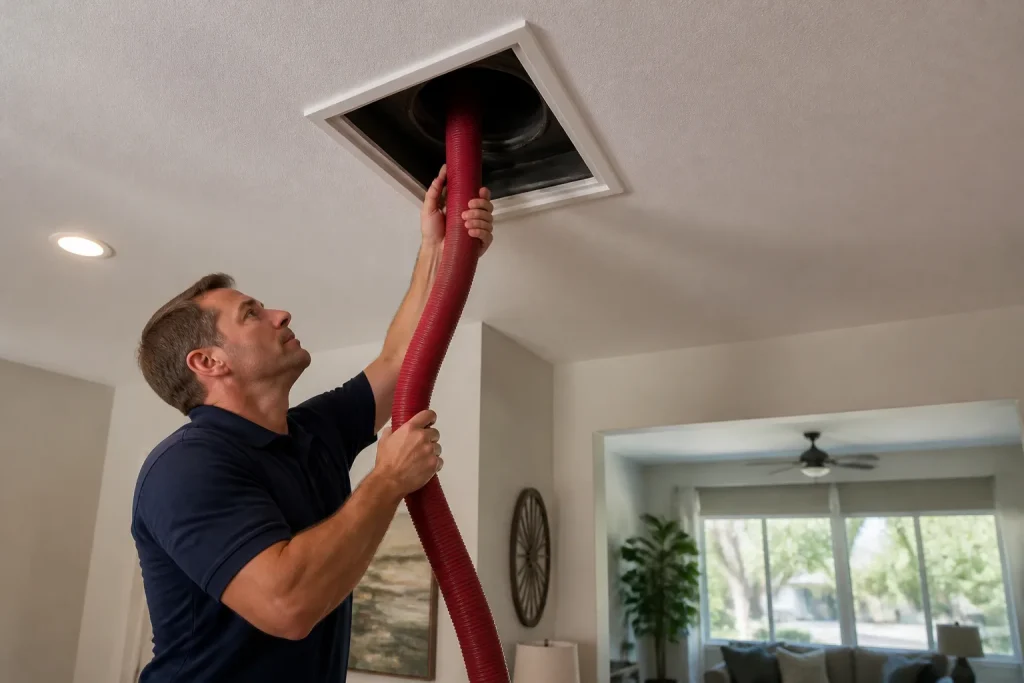
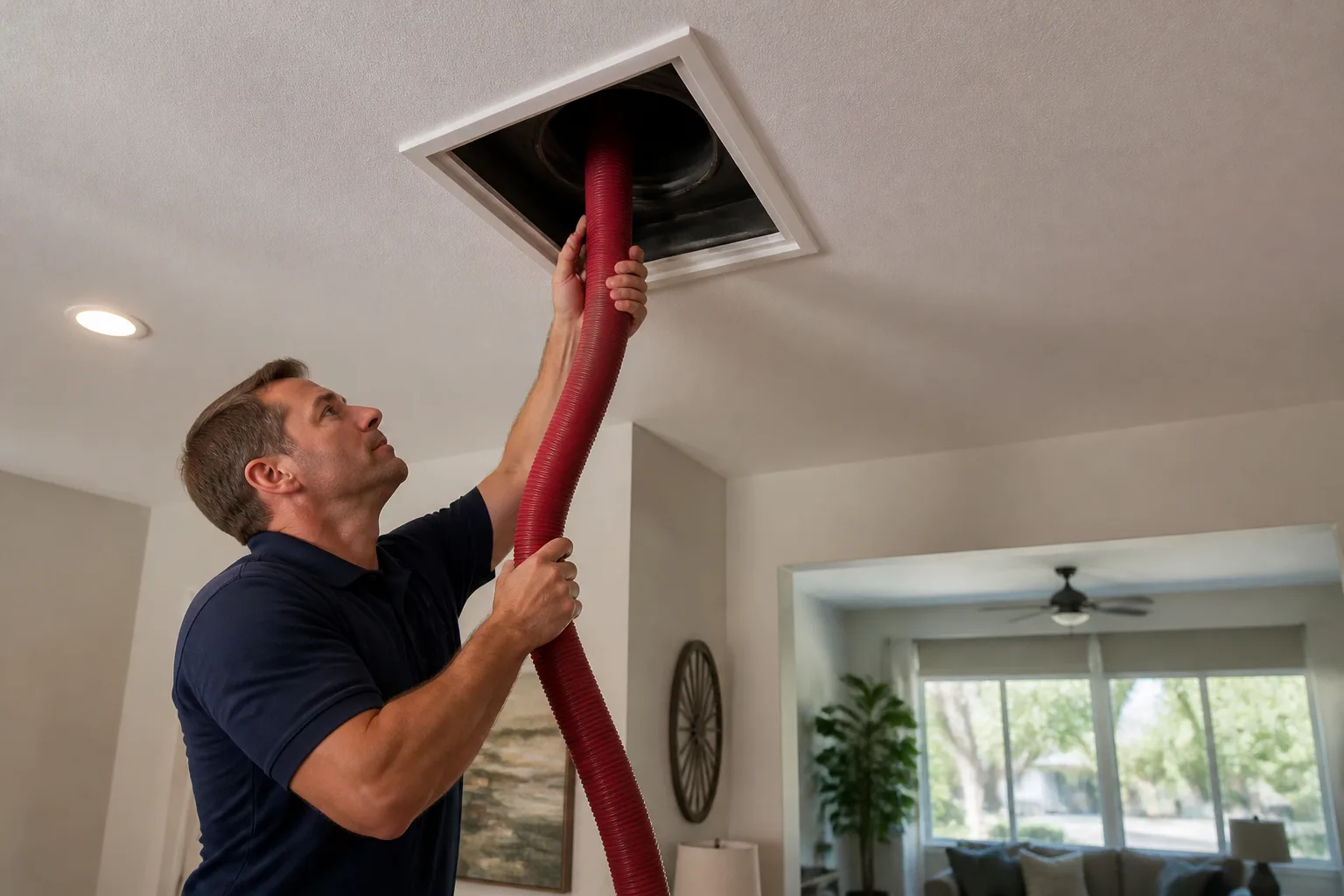
Here’s how a negative-air setup works in plain terms. The technician cuts an access hole in the supply plenum and attaches a vacuum hose with an 8- to 12-inch diameter. The machine runs continuously, creating a pressure differential: air inside the duct system rushes toward the vacuum because the vacuum is pulling harder than the surrounding room. This means that when a rotary brush or air whip knocks dust loose from the duct walls, the debris has nowhere to go except into the vacuum hose. The ductwork is under negative pressure, so every crack, seam, and register becomes an air intake point rather than an air exhaust point.
If the same job were done without sealing the system, agitation would push dust out of every supply register. That’s the opposite of cleaning. We’ve walked into Sunnyvale homes after other companies finished a “cleaning” and found dust coating the furniture near ceiling registers. That’s a tell-tale sign of positive-pressure agitation, or a machine that wasn’t running at all during agitation.
Nikro is the benchmark in this space because their HEPA filtration standard matches what NADCA specifies for source removal in occupied structures. A HEPA filter captures 99.97% of particles down to 0.3 microns. The air leaving the machine is cleaner than the air in most homes. That matters if you’re cleaning ducts because someone in the house has allergies, asthma, or a compromised immune system. You don’t want the remediation to add airborne particulate.
For homes in Sunnyvale’s older neighborhoods near El Camino or the Birdland district, we typically see metal trunk-and-branch systems from the 1960s and 70s. These respond exceptionally well to negative-air extraction because the smooth metal walls release dust readily when agitated. The pressure differential then carries it out. Fiberglass-lined ducts in newer developments off Wolfe Road or near Lakewood require a gentler agitation approach so the fiberglass lining isn’t damaged. Nikro machines handle both scenarios, but the operator needs to know the difference. That’s a skillset, not a machine feature.
What Proper Nikro-Based Cleaning Looks Like From the Homeowner’s Perspective
You’re about to pay several hundred dollars for a service you can’t see happening inside your walls. That’s a reasonable thing to be skeptical about. Here’s what a legitimate Nikro-based duct cleaning in Sunnyvale should look and sound like:
- The access panel is visible. A proper cleaning requires cutting an 8×10-inch hole in the supply plenum, usually near the furnace or air handler. The technician should show it to you before starting. After the job, the panel is sealed with a metal patch and foil tape or screws. If you never see an access hole, ask where the vacuum is connected. A legitimate source-removal cleaning can’t happen through a 1-inch register opening.
- The machine runs the entire time. From the moment agitation starts until the final pass is complete, the negative-air unit should be audible. We run ours continuously. If the machine gets turned off while brushing happens, the system loses negative pressure and debris escapes.
- Registers are sealed in sequence. A proper technician seals off a section of registers, opens one at a time for agitation, then moves to the next zone. This concentrates the vacuum’s pull on a single branch run at a time. It’s slower than opening everything at once, but it’s what actually removes material. If all registers stay open, the vacuum pulls from the path of least resistance and half the system gets a superficial pass.
- You hear agitation and feel register suction. You should hear the brush or air whip moving through the ducts. At an open register being actively cleaned, you should be able to hold a tissue near the opening and see it flutter toward the duct. That’s negative pressure doing its job.
One more thing worth mentioning: a technician who tells you they’ll use Nikro equipment should be able to show you the unit. Not a photo. The actual machine on the truck. It’s a large, freestanding metal cabinet with a filter stack, not something small enough to carry in one hand. If the “HEPA unit” is the size of a carry-on suitcase, ask questions.
Source Removal vs. Contact Vacuuming: Why the Method Determines the Result
NADCA, the National Air Duct Cleaners Association, defines proper duct cleaning as “source removal.” That means removing debris at its point of origin: the duct walls, the plenum, the blower housing. It does not mean pushing a vacuum hose through a register and hoping for the best.
Contact vacuuming, where a small hose touches the duct surface directly, removes whatever is directly beneath the hose tip. It has a capture radius measured in inches. Source removal with a Nikro negative-air system and mechanical agitation removes material from the entire duct surface area, including debris that’s adhered to metal walls from years of condensation cycles and static cling. In a 2,000-square-foot Sunnyvale home, a full duct system contains roughly 150 to 250 square feet of internal surface area. Contact vacuuming might clean 20% of it. Negative-air extraction with proper agitation reaches the entire surface.
This distinction matters because homeowners often can’t tell the difference afterward. Dust settles in ducts between cleanings no matter what method was used. The difference shows up in what gets tracked through the home afterward and how much visible dust accumulates on surfaces within a few weeks. A source-removal cleaning leaves less airborne particulate in your home during and after the job. That’s the whole point of investing in professional equipment rather than hiring whoever offers the lowest number over the phone.
In one home near Serra Park in Sunnyvale, we pulled 14 pounds of drywall dust and construction debris from ducts that had been “professionally cleaned” two years earlier. The prior technician had used contact vacuuming through the registers and left the trunk lines untouched. We filled two Nikro filter bags. The homeowner stood there watching and couldn’t believe the volume. That’s what’s sitting in many Sunnyvale homes built or remodeled without sealed duct protection during construction.
Why Nikro HEPA Filtration Matters for Sunnyvale’s Air Quality Reality
Sunnyvale sits in a bowl between the Santa Cruz Mountains and the East Bay hills. When wildfire smoke settles over the South Bay, which happens at least a few weeks every year now, it settles into homes through passive air exchange. Your HVAC system recirculates that particulate. Your ducts accumulate it. The next time the blower kicks on, it redistributes what settled.
A HEPA-filtered Nikro unit captures particulate during cleaning rather than exhausting it outdoors or back into your home. Non-HEPA units without proper filtration do exactly that: they clean your ducts by moving the dust elsewhere. Out the front door, into the garage, back through your living space. If the machine’s exhaust is pointing at an open window and the wind shifts, you’ve just aerosolized everything that was inside your ductwork.
This is also where brand familiarity with IAQ equipment comes into play. We work with Air Duct Cleaning in Sunnyvale using negative-air extraction as the foundation. But the post-cleaning recommendation often involves filtration: Honeywell media filters for ongoing particulate capture, Aprilaire whole-home purifiers for homes where allergens are the concern. The cleaning removes what’s already there. The filtration prevents rapid reaccumulation. One without the other is half a solution.
For Sunnyvale homeowners who’ve lived through the 2020 fire season haze, this isn’t theoretical. Your ductwork is a particulate reservoir. A HEPA-filtered cleaning is the only type that genuinely removes that reservoir rather than relocating it.
What It Costs and How to Compare Quotes Honestly
Air duct cleaning in Sunnyvale typically ranges from $325 to $600 for a standard single-family home under 2,500 square feet, depending on system size, number of returns, and accessibility. Homes with two furnaces or extensive duct runs will run higher. Here’s a realistic breakdown:
| Service Component | Typical Range |
|---|---|
| Single-system duct cleaning (up to 10 vents) | $325 – $450 |
| Each additional vent | $15 – $25 |
| Second return or second system | $75 – $150 |
| Dryer vent cleaning (add-on) | $75 – $125 |
| Access panel fabrication and sealing | Included in proper quote |
| Honeywell or Aprilaire filter install | $95 – $350 depending on model |
The reason some quotes are dramatically lower is simple: the contractor is pricing contact vacuuming, not source removal. A $99 duct cleaning is not the same service. It can’t be. The equipment and labor required for negative-air extraction with Nikro or Rotobrush machinery has real costs. We own our equipment and we run it on every job, which is why our quotes reflect the actual method rather than a teaser price that gets upsold when the technician arrives.
When comparing quotes in Sunnyvale, ask three questions: Will you cut an access panel into the supply plenum? Will the negative-air machine run throughout agitation? Is HEPA filtration included? If any answer is vague or evasive, you’re not comparing the same service.
How Nikro Compares to Rotobrush: Two Tools, One Job
We’re frequently asked about the difference between Nikro and Rotobrush equipment. Here’s the honest version. They serve different functions.
Rotobrush is primarily an agitation system: a motorized brush head that spins inside the duct, breaking debris free from the walls. It’s inserted through vent openings and can navigate branch runs effectively. Nikro is primarily an extraction system: a negative-air vacuum that creates the pressure environment and captures the material the agitation releases. Professional duct cleaning firms use them together. The Rotobrush loosens, the Nikro captures.
A technician using only a Rotobrush without negative-air extraction is loosening debris and hoping the machine’s onboard vacuum is sufficient. For light dusting, sometimes it is. For the volume of material in a 50-year-old Sunnyvale home’s duct system, it isn’t. The loose material settles back into the ducts or gets pushed into the home when the furnace runs. A technician using only a Nikro vacuum without agitation gets surface-level dust removal. The adhered material stays. The combination is what NADCA’s source-removal standard assumes.
When someone tells you they’ll clean your ducts with a Rotobrush, ask what they’re using for negative-air extraction. If the answer is “the Rotobrush has its own vacuum,” understand that the tool’s onboard collection is not equivalent to a dedicated Nikro HEPA unit. It’s the difference between a vehicle’s built-in radio and a sound system. One is adequate for casual use; the other is engineered for the job.
When to Call a Pro Rather Than Wrestling With It Yourself
Here’s the truth about DIY duct cleaning. You can rent equipment. You can buy inspection cameras. You can watch hours of YouTube tutorials. But source removal requires cutting into your duct system, sealing it properly afterward, and running equipment that pulls enough air to create meaningful negative pressure. If you don’t do all three correctly, you either don’t clean anything or you make your indoor air worse.
We’ve also seen DIY attempts go wrong mechanically. A homeowner in the Heritage District of Sunnyvale cut an access hole, ran a rental machine without sealing the return side, and ended up with insulation blown into his bedroom through the supply registers. The cleanup cost more than a professional cleaning would have.
If you’re in Sunnyvale and notice visible dust accumulation around registers, a musty odor when the HVAC runs, or a recent remodel that left construction dust everywhere, call (866) 593-7291. We’ll assess the system, show you what’s actually in your ducts with an inspection camera, and give you a flat quote before any work begins. No surprise charges, no bait-and-switch pricing.
Related services in Sunnyvale: Dryer Vent Cleaning in Sunnyvale is not an upsell for us. It’s a fire-prevention service. Lint accumulation in a dryer vent is the leading cause of dryer fires in the U.S., and a clogged vent also makes your dryer run longer, which costs you money in wasted energy and wears out the heating element faster. If your laundry takes two cycles to dry, that’s not a dryer problem. That’s a vent problem. We treat it with the same source-removal methodology we apply to ductwork.
And if we find damaged ductwork during a cleaning – a disconnected branch line, a crushed flex duct, a rusted-out section of trunk line – we don’t just note it and leave. Air Duct Repair in Sunnyvale is part of the same visit whenever the repair is straightforward. We clean it. If it’s damaged, we repair it. That’s the clean-through-repair continuum that separates a specialist from a generalist who can only clean and move on.
The Bottom Line
Nikro equipment in Sunnyvale is a meaningful signal that a contractor uses professional-grade negative-air extraction rather than consumer workarounds. But equipment alone doesn’t guarantee a proper cleaning. The system must be sealed, the machine must run continuously, registers must be zoned, and agitation must be combined with extraction. If you’re comparing duct cleaners, ask about method before price. A proper source-removal cleaning on a typical Sunnyvale home costs between $325 and $600. Anyone quoting dramatically less is almost certainly not providing the same service.
What we recommend: get an inspection first. See what’s actually in your ducts. Then decide whether cleaning makes sense for your home. If you’re in Sunnyvale and need help, Duct Cleaning Sunnyvale offers free estimates. Call (866) 593-7291 and we’ll walk you through what we do and why we do it that way.
Frequently Asked Questions
Nikro air duct cleaning refers to duct cleaning performed with Nikro Industries negative-air machines, which create a pressure differential inside your duct system that captures loosened debris rather than blowing it into your home. The machines use HEPA filtration to capture 99.97% of particles down to 0.3 microns before air is exhausted. It’s the same equipment standard NADCA specifies for source-removal cleaning in occupied structures. In Sunnyvale homes, this is particularly relevant during wildfire season when ductwork accumulates fine particulate you don’t want aerosolized. Call (866) 593-7291 for a free estimate on a Nikro-based cleaning.
In Sunnyvale, professional Nikro-based air duct cleaning typically costs between $325 and $600 for a standard single-family home under 2,500 square feet. Factors that affect price include system size, number of returns, accessibility of the air handler, and whether dryer vent cleaning is added. Quotes below $200 almost always indicate contact vacuuming rather than source removal, which is a different and far less thorough service. Call (866) 593-7291 for an exact quote on your system. Estimates are free and we always show you the access panel and equipment before starting.
A proper Nikro-based duct cleaning in Sunnyvale has visible and audible signs: an access panel cut into the supply plenum (which should be shown to you before work begins), the negative-air machine running continuously throughout the job, registers sealed and opened in zones, and a tissue test at an open register showing air pulling into the duct. After the job, ask to see the inside of a supply branch with an inspection camera if possible. Legitimate contractors will be able to show you before-and-after views. If none of these signs were present, you likely received a superficial cleaning.
Most homes benefit from air duct cleaning every 3 to 5 years. Sunnyvale homes that went through the 2020 wildfire smoke season, have pets, recently completed a remodel, or have residents with allergies or asthma should consider the shorter end of that range. Homes near construction sites along El Camino Real or in newer developments off Lawrence Expressway accumulate particulate faster. If you’re unsure, an inspection with a camera will show you whether cleaning is warranted. Ductwork doesn’t need cleaning on a strict schedule; it needs cleaning when there’s visible accumulation. Call (866) 593-7291 and we’ll help you determine whether it’s time for your system.
Written by the team at Duct Cleaning Sunnyvale, serving Sunnyvale since 2015.
Need Air Duct Cleaning Help?
Call Duct Cleaning Sunnyvale - licensed & insured, with free written estimates in Sunnyvale.
(866) 593-7291